K. U.M. Underwater Seismometer NAMMU - The World's Most Advanced and Reliable Underwater Seismometer OBS
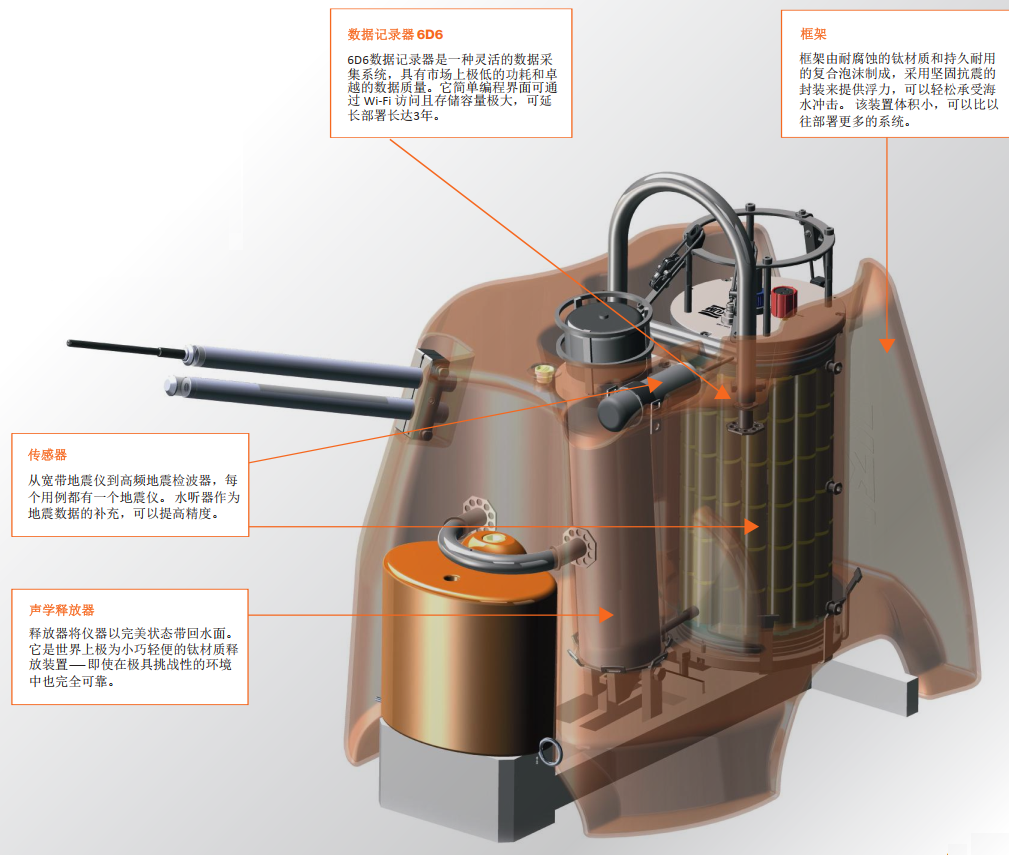
Compared to earlier models, NAMMU's buoyancy shell is designed to simultaneously protect sensitive sensor systems from impacts and accidental collisions during transportation, deployment, and recovery. The sensor is directly located at the bottom of the pressure pipe and in direct contact with the anchor, which is crucial for good coupling. Like OBS, the anchor itself is asymmetric in weight distribution, so when the two are combined, the entire system does not tilt during descent and can land perfectly on the seabed.
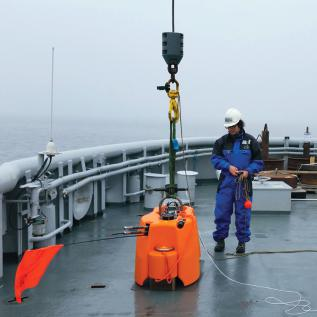
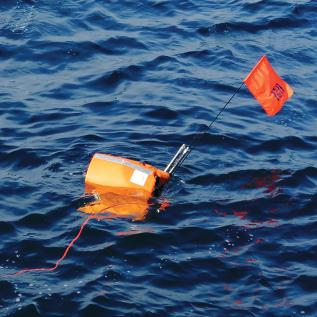
During the recycling process, when the anchor is released, the OBS will rise and float vertically to the surface, with flashing beacons and orange flags high above the water to ensure clear visibility and quick recycling. All components exposed to seawater are made of polyethylene or titanium; The obtained instrument is highly sturdy and completely salt water resistant, making it very suitable for long-term use.
Data loggers are constantly improving in terms of accuracy, robustness, and low energy consumption. The signal-to-noise ratio of the four channels exceeds 142 decibels, and the energy consumption is only 125mW. This is a high-performance kit. Equally impressive, this 120 second broadband seismometer can operate completely autonomously and has a precisely tuned dynamic range. The total energy consumption of this device is less than 1/3 watt. Therefore, despite its small size, data can be continuously recorded for up to 13 months. If equipped with a battery expansion pack, the recording time can be extended for up to 36 months.
Simply insert the memory drive unit from the outside and operate the entire instrument through Wi Fi and a browser. All of this is why NAMMU is as user-friendly and easy to operate as the TV in your living room.


|
K. The founders of U.M. first came into contact with the Underwater Seismograph (OBS) in 1996. They immediately became extremely interested in the combination of its high-precision electronic equipment and absolute reliability. One year later, they jointly registered K.U.M. to develop and improve a series of scientific research equipment for deep-sea environments. In 1999, K.U.M. participated in a scientific expedition, which provided the team with first-hand experience in operating OBS, which was considered highly advanced at the time. This experience also highlights several areas where they believe improvements can be made. It is worth noting that they realized that the release device was too large and heavy, the materials used were too corrosive, the quality of the collected data was poor, and the user interface was completely outdated. Considering all of these factors, the K.U.M. team has decided to take on the challenge of creating a better system. In 2001, K.U.M. began developing its own acoustic release device with the aim of eliminating the shortcomings of other models on the market at that time. In 2003, K.U.M. launched the first titanium material release device KUMQuat, which is still considered a leader among similar products to this day. In the following years, K.U.M. built a broadband OBS, later known as LOBSTER, to meet the interests of several universities. This is the team's first attempt to design a complete OBS system. However, although LOBSTER is very sophisticated and advanced, it is not perfect. Therefore, in 2013, K.U.M. began developing a new OBS that would realize the team's new vision: to provide extremely high performance while maintaining ultra-low energy consumption, the size of the OBS should be small enough and the safety performance should be high enough to be used on ship decks in the open sea. The design of this new type of OBS is very promising, so its development has received support from the state of Schleswig Holstein in Germany and the European Union. After two and a half years of development work, K.U.M. proudly launched a new deep-sea OBS concept called NAMMU; This is indeed an extremely advanced instrument that has received great attention from the market since its launch. Since then, NAMMU has proven itself in dozens of tasks, and its data quality, reliability, and user friendliness have sparked widespread enthusiasm for the concept. |
|
|
deploy A 20 foot container can transport up to 50 sets of NAMMU underwater seismometers. Accessing the network interface through Wi Fi allows for simple and intuitive programming - accessible from a laptop or smartphone without the need for specialized software. It usually uses a free settling system and can also be deployed through ROVs. practice Due to low power consumption and reliable storage of important instrument data and metadata, deployment time can reach up to three years. The compact instrument design promotes good coupling, and the hydrodynamic shape design can achieve industry-leading low-level external noise. Recycle An extremely reliable acoustic release device is the key to recycling. Other features include a fast positioning instrument using wireless beacons and flashers, as well as the ability to quickly download data through external storage StiK. Through our portable open-source software, data can be easily and quickly converted into mSEED. |
 |
 |
|
 |
|